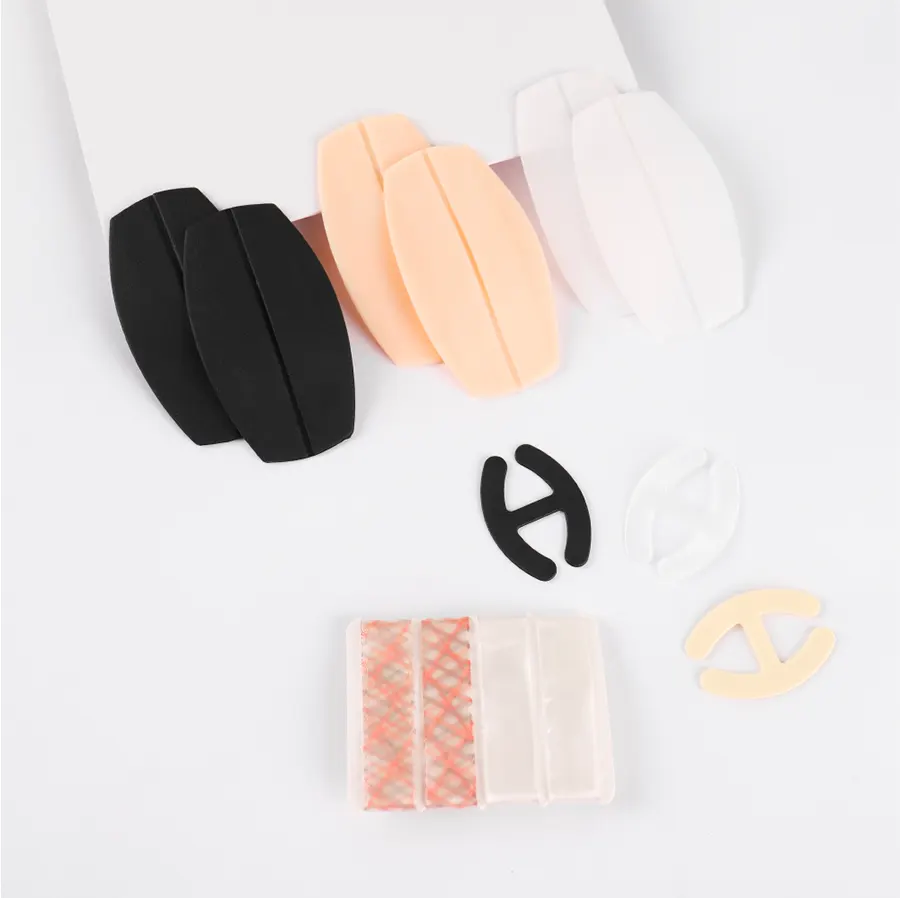
Disposable nipple covers look like the simplest item on the intimates shelf, which is how they get mis-specified: no cup to mold, no fit session to run. What you buy is a stack of thin layers — face, coating, liner, wrap — plus a die-cut stroke and a carton, each with its own supplier and failure signature.
The specification layer is narrow: which face suits which channel, which coating survives a single-wear price point, how liner and wrap change assembly, and what each adds to unit cost.
Why Disposable Lines Exist
Four channels pull a disposable SKU onto the shelf, and none starts with a customer asking for a cheaper cover. Hygiene policy is usually first: rental lingerie, bridal salons, and costume houses will not put a used adhesive face back on a shared rack, so the pack is a compliance artifact before it is a product.
The second is the trial insert — one pair in a garment bag, a festival kit, or bundled with an adhesive bra. The third is production demand, where a crew works through pairs with no laundering step. The fourth is the pharmacy, supermarket, and travel-retail shelf.
Each channel changes the specification: hygiene buyers care about the individual wrap, trial buyers about card and count, production buyers about how the face reads under lighting, shelf buyers about label text and case pack. Format trade-offs and shelf position sit in disposable versus reusable nipple covers; the faces below are those listed under the disposable nipple cover category.
Face Materials: Four Substrates, Four Cost Curves
The face is what the customer sees, largely what decides whether the product disappears under clothing, and what carries the coating. Four substrate families cover most of the range and are not interchangeable; cost direction here is relative.
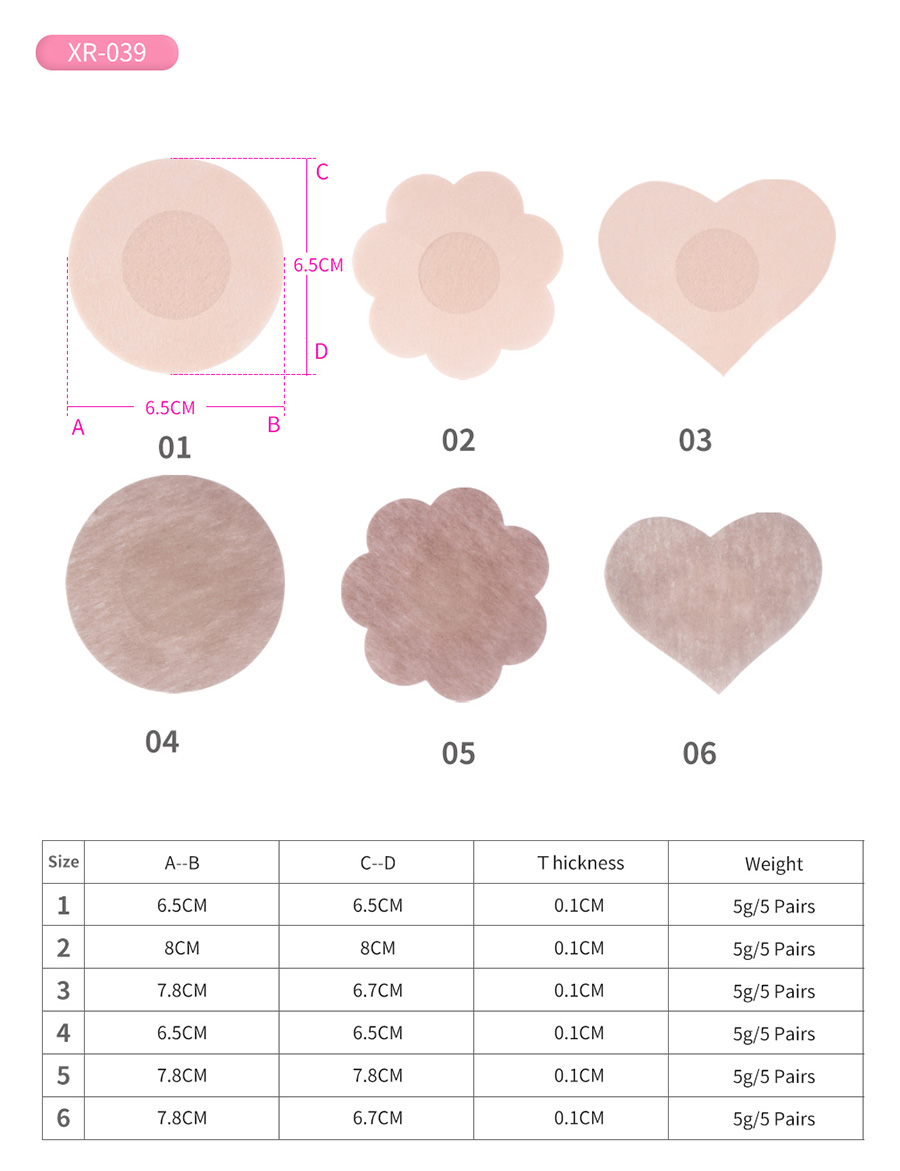
Non-woven. IL non-woven disposable pastie is the workhorse: matte, even coating uptake, clean at high stroke counts, and usually the lowest substrate input. Dry comfort and edge wear on a small diameter are the usual complaints; the page lists a bio-silicone glue on a breathable face. Raso. UN satin disposable pastie is specified when the edge will be seen; its copy pitches party nights and formal occasions, which is bridal and gifting under another name. Print results vary more on a floated weave.
Poliestere. IL polyester disposable pastie holds a finer edge than non-woven and is the thin, low-profile option; its page states a matte finish that does not throw camera flash and a 7.5 cm cut sold as the fuller flower for plus-size coverage. Static cling on unwrapping is worth checking. Spandex. UN spandex disposable pastie buys stretch, so the rim closes on a curved geometry instead of lifting. Its page lists a 2.36-inch diameter and an adhesive it labels superior, both to test. The trade-off is a die allowance that shifts with stretch and a cut that deforms when the liner is stripped.
| Face | Show-through | Conformability | Print and coating | Cost direction | Channel fit |
|---|---|---|---|---|---|
| Non-woven | Can read as a fabric patch | Low on small diameters | Even uptake; the easiest of the four to print | Lowest substrate input | Volume shelf, trial inserts |
| Raso | Edge catches light | Rigido; the shape does the work | Variable on a floated weave | Mid; higher ticket | Nuziale, regalare, stage |
| Poliestere | Magro, low rim shadow | Modest | Good print and embossing | Mid; thinnest per unit weight | Everyday consumable |
| Spandex blend | Low once the rim closes | Highest of the four | Die allowance shifts | Upper; sampling overhead | Fuller coverage, movement |
Adhesive at a Disposable Price Point
Coating choice here is an allocation question: how much of the per-piece budget goes to the face and how much to the tack that holds it. Tack build-up, skin contact and sensitivity handling sit in adhesive used on sticky bras. The disposable constraint is narrower: one session of hold, then clean release from a liner.
A hydrogel or water-activated system builds tack from skin moisture, which suits short wear windows and eases removal; it is also the class most sensitive to humidity and storage film integrity. A thin-coat pressure-sensitive system is present on contact and needs no moisture to develop; edge lift is usually its first symptom of under-coating, because you pay for coating weight by the piece.
The coated-face example here, IL bio-glue disposable nipple cover, shows how loose this gets: its features line says it can be washed and reused about ten times, its spec table says Disposable, and its material field says 95% poliestere, 5% spandex. The fabric faces give their own windows — 10 hours or more for non-woven, six at a time for satin, and a peeled spandex cover that has lost its tack. Judge a coating on your chosen face; one class reads differently on non-woven, raso, and stretch. Define failure as lift, migration, or visible slip before testing. None names a method or sample size, so the record behind any session figure you print stays [待确认].
Liner, Die-Cut and Coverage Bands
The liner is usually the cheapest overlooked layer. Release paper is inexpensive and cuts cleanly but can fiber-shed at the edge, which reads as lint on a dark face; the polyester page tells the wearer to peel off back paper, so that is what it ships with. A coated release film lies flatter and releases more consistently at a higher cost per piece; its release force has to match coating weight.
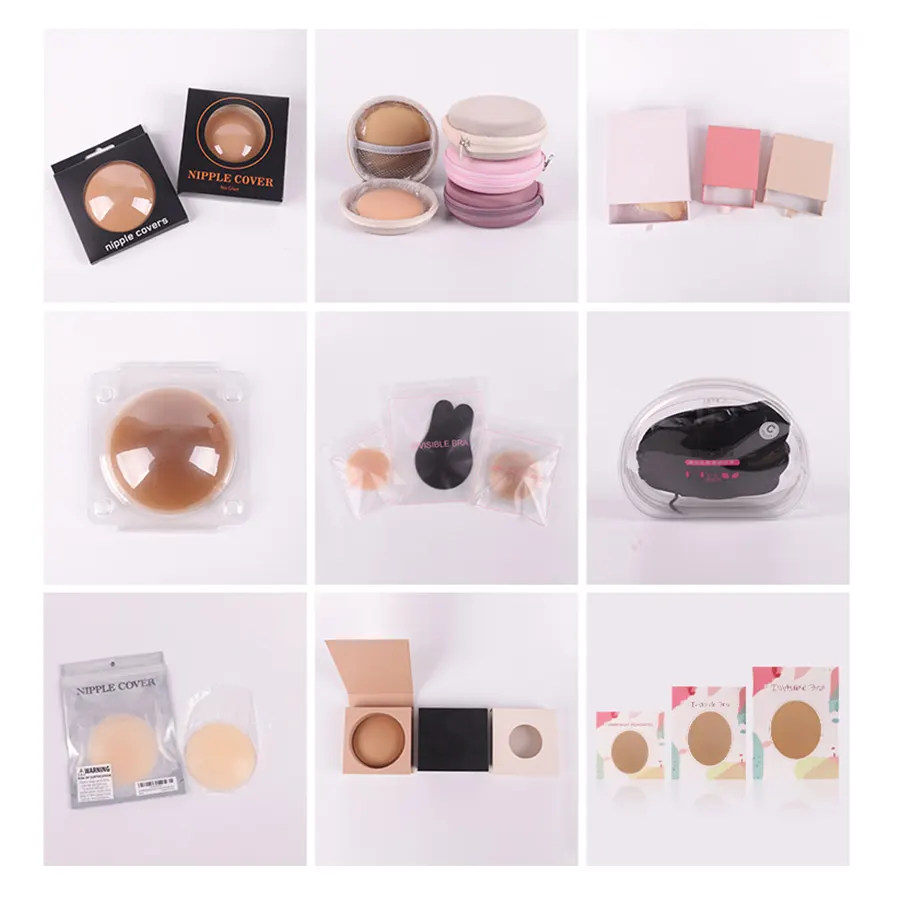
Wrap format is the second decision. Pairs sharing one liner generally assemble faster and cheaper, and every pair is touched during unpacking. An individual sachet per pair is what hygiene-driven channels usually ask for; it adds a material and an assembly step and changes carton count. Pack structure and wrapping routes are documented in custom packaging for silicone nipple cover.
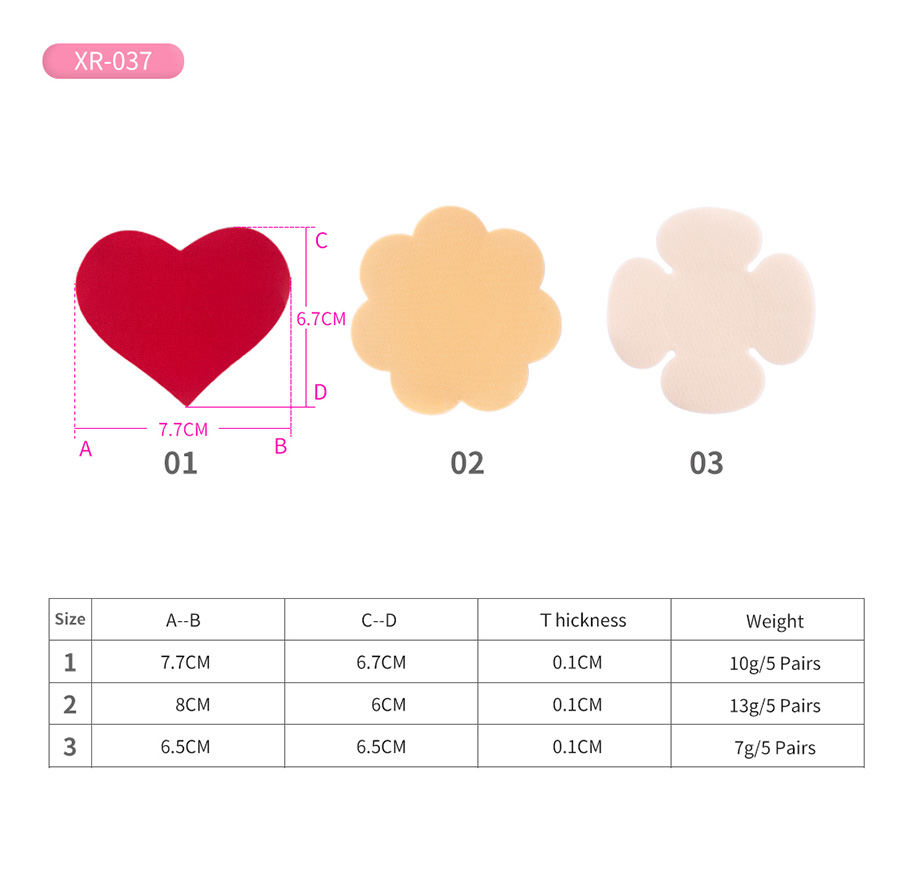
Shape and diameter come third. Petal pasties and fuller-coverage rounds sit in a narrow band of diameters that interacts with the face: a stiff non-woven on a small diameter concentrates lift on a short edge, while a stretch face needs its die allowance set under tension. Nesting efficiency decides pieces per stroke, so a shape that looks trivial on artwork can add a second die.
Counts and Size Matrix
Count per box is a channel decision wearing packaging clothes. One pair sells at an impulse position, three to five is the core consumable pack — the counts the pages here declare per OPP bag — eight to twelve serves a crew or a rental house, and larger counts move you out of retail. Mixed coverage inside one box answers two geometries from one SKU: a single-diameter box is usually cheaper per piece, a mixed box is easier to sell.
Format arithmetic is what is specific to this family: face substrate, coverage band, count per box, and wrap format each multiply, and every added value is another production line and another minimum order. Confirm whether that minimum counts pieces or pairs.
| Pack format | Coverage bands | Wrap structure | Channel fit | Cost behavior |
|---|---|---|---|---|
| Single pair | One diameter | Wrapped on a card or in a sachet | Impulse, travel retail, bundling | Wrap and card dominate |
| Three to five pairs | One band, or mixed small and fuller | Shared liner, or wrapped per hygiene policy | Core retail, regalare, pharmacy shelf | Balanced; better carton efficiency |
| Eight to twelve pairs | Two bands mixed to cover a range | Stack with interleaved liner, or trays | Rental houses, production crews | Lowest wrap cost per piece |
| Assortment carton | Several diameters, two or three faces | Wrapped and sorted by band in-case | Distributors testing a range | Highest picking cost; multiplies order lines |
Unit Cost Structure: Six Line Items
Six inputs move the number. Face substrate moves with fiber, weight, and pieces nested per stroke; coating with weight per piece and class; liner between paper and coated film; wrap with film gauge and whether a machine or hands close it; die-cut with stroke count and shared tooling; carton with print colors, insert cards, and case pack.
Public wholesale listings quote a non-woven disposable pastie around US$0.08–0.15 per piece at volume tiers near the 30,000-piece level, and coated or fabric-faced disposables above that. Those are market reference points, not a Xinke quotation. The disposable pages here list MOQ 1,000, so most first orders land below that tier. Once wrap, liner, and assembly are counted, the substrate is rarely the largest share.
The lever buyers pull first, coating weight, surfaces later as returns. The cleaner payback is carton efficiency: cases per shipment change landed cost without touching the layer against skin. Read the tier too: if it is quoted per piece, a five-pair pack needs five times the volume of a single to reach the same band, and a split assortment lands in its own tier.
Hygiene Policy and “Single-Use” Wording
“Single-use” is a claim you choose, then a specification you defend: state how many sessions the face, coating, and liner ran, and what was recorded. A pack that says single-use and one that says nothing are different products. Say nothing and you inherit care instructions, since a reader who assumes reuse looks for the laundering procedure in how to clean and reuse nipple covers.
On the label, a textile face is described by fiber content, and in the US market that follows 16 CFR Part 303, under the Textile Fiber Products Identification Act. The material fields here read Non-Woven, tessuto di raso, Tessuti in poliestere, and mutispandex — trade names, not declarations; UN 95% poliestere, 5% spandex split is. Put fiber percentages on the quote sheet. Where an item is sold as personal care rather than apparel, 21 CFR Part 701 on cosmetic labeling is the framework a reviewer reaches for.
Neither citation converts into a clearance, approval, or safety claim for your product, and a material certificate does not become skin-compatibility wording without its own testing scope. Above both sits platform and retail paperwork — document packs, material declarations, acceptable phrasing — handled channel by channel in lingerie packaging compliance, and resolved before artwork rather than after a rejection.
Domande frequenti
Can you reuse disposable nipples?
Some survive a second wear, but a disposable SKU is a single-session system: a thin coating on a face not built for handling after use, where second-wear failure is usually edge lift or liner lint. If your channel wants reuse, that is a heavier coating and a handling-grade face, tested and labeled as such.
Reusable pasties vs disposable: which one should a retailer stock?
Format trade-offs and retail price bands sit in the disposable-versus-reusable comparison; channel and shelf position decide them. Once disposable is the purchase, the remaining questions are material, adesivo, liner, die-cut and count.
Types of nipple covers: how do petal pasties compare with full-coverage shapes?
The useful split here is coverage band plus face substrate. A small petal on a stiff face is the least forgiving pairing, because lift concentrates on a short edge, while a fuller band on a stretch face closes the rim and holds through movement.
How many pieces per box should I stock?
Match the count to who consumes the product: one pair for an impulse or bundled position, three to five for core retail and gifting, eight to twelve for a crew or rental house. Then check the tier arithmetic, since volume tiers may be set per piece rather than per box.
Pensieri finali
Specify the stack rather than the label: choose the face from the channel, then fix coating weight and liner against a stated single-session target. Wrap format and count belong on the same sheet as the substrate; together they decide what a piece costs.
Keep the range shallow and the wording honest. Every extra face, coverage band, count, or wrap option is another order line in its own volume tier, and an undeclared reuse assumption is a return you have not read yet. Test the session you claim, label the fiber content your reviewer signs off, and open the line with the sample offer the category page carries before committing a SKU count.