
A silicone bra, Bra adesivo, or nipple cover inquiry comes back as a spreadsheet or a PDF, and no two factories format it the same. The fix is not to chase a lower unit price. It is to read a quote as seven cost blocks, each moving in response to a different decision you make.
This article reads one silicone intimate quote line by line: what each line represents, what moves it, and what you have to state for two quotes to be comparable. Four things are deliberately out of scope: startup-level money planning, current tooling price ranges, the private label versus OEM model comparison, and shipment classification. Each has a dedicated guide on this site, linked instead of restated.
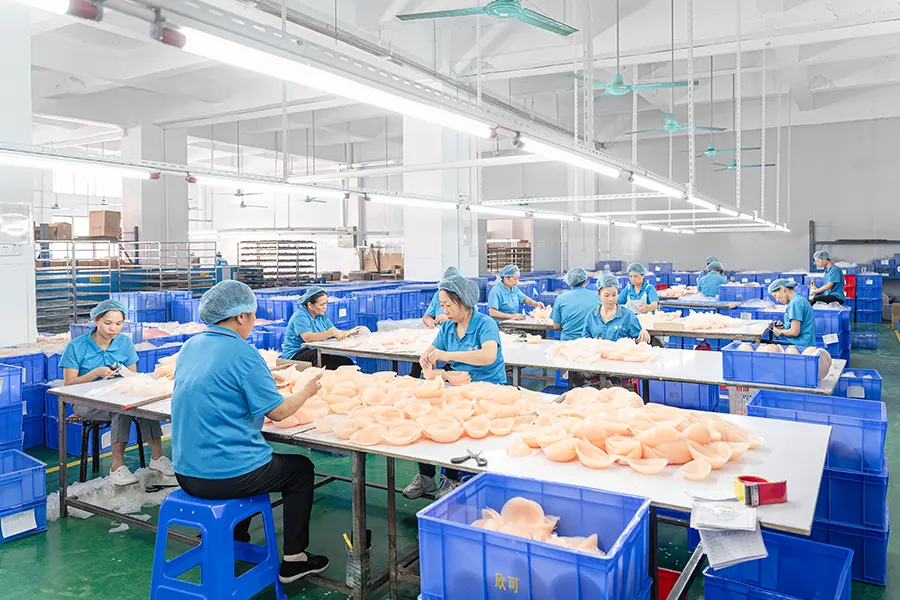
The Line Items on a Silicone Intimate Quote
Conclusion first: almost every quote for adhesive silicone intimates is built from the same seven blocks — material, ferramentas, adhesive and coating, processing, embalagem, teste, and freight. A supplier can merge them, rename them, or hide them in a single unit price, but none disappears.
The table below shows what each block looks like on the paper, how it is billed, and what moves it.
| Line item | How it appears on the quote | Who pays and how it is billed | What moves it |
|---|---|---|---|
| Material | A per-piece entry, or a weight line showing grams per piece | Inside unit price on every order | Part mass, wall thickness, silicone grade |
| Tooling | A separate one-time line, sometimes folded into a sample charge | Buyer pays once per cavity set | Whether the factory already holds a matching mold, shape complexity, cavitation |
| Adhesive and coating | Either merged into unit price or quoted per coated piece | Inside unit price; a surcharge line if you change systems | Adhesive system, coverage pattern, coat weight, release liner |
| Processing | Rarely itemized; implied in the unit price and lead time | Inside unit price | Forming steps, trim and finishing, number of operations, tolerance band |
| Embalagem | A per-set price plus a separate print setup line per color | Buyer pays per packed unit plus one-time print setups | Pack structure, print color count, SKU breadth |
| Testing | A one-time line per construction, or a note saying reports are available | Buyer funds third-party tests; routine in-house checks sit in unit price | Component changes, destination market, test house chosen |
| Freight | Either a delivery line or a sentence about where the price stops | Whichever party the agreed delivery point puts it on | Carton count, packed quantity per carton, transport mode, delivery point |
The seven blocks behave differently depending on whose design you buy: the cost difference between private label and full OEM is owned by private label vs. OEM lingerie manufacturing. And which blocks appear depends on the product family — the standard shapes in the adhesive bra category let a buyer skip the tooling block entirely.
What Each Line Item Responds To
Conclusion first: no cost block moves in response to your whole specification — each reacts to two or three specific decisions. The sensitivity table pairs the six factors you control with the blocks they hit and your practical control over each.
| Spec decision | Line items it moves | Your practical control |
|---|---|---|
| Order quantity and reorder tiers | Every fixed charge amortizes here: ferramentas, test setups, print setups | High — this is the strongest lever a buyer holds |
| Material grade and hardness | Material mass, processing time, coating window | Medium — must be bound to a construction, not chosen in the abstract |
| Adhesive system and coverage | Coating cost, defect rate inside processing, test scope | Medium — a change reopens the testing block |
| Color count | Pigment setup per separation, packaging print, order-line splits | High — usually the cheapest reduction available |
| Size steps in the range | Mold cavities, packaging SKU count, tied-up inventory | Medium — each added step multiplies fixed charges |
| Packed pieces per pack | Packaging per-set price, contagem de caixas, freight per piece | High — pack geometry is a buyer decision, not a factory default |
The pattern worth memorizing: quantity amortizes the fixed blocks, simplification removes the variable ones.
What each factor physically changes inside the factory follows the process route documented in how to customize a silicone bra in a factory.

Mold and Tooling: When the Line Appears
Conclusion first: a tooling line appears only when your shape does not exist in the supplier’s cavity pool. That explains why two near-identical products can produce quotes that do not reconcile — one factory amortizes an old mold through unit price, the other quotes a new one openly.
When the line appears, treat it as three questions rather than one number: cost per cavity set, cavities per stage, and the quantity over which the charge spreads into unit price. Current tooling price ranges and the amortization logic behind them belong to OEM vs ODM silicone nipple covers and are not restated here.
Three points to fix in writing before tooling money moves: who owns the mold after the program, whether your cavities can be reused on reorders at the same unit price, and what happens to the charge if the program is cancelled.
Adhesive and Coating Cost
Conclusion first: the adhesive face is the most commonly hidden line on a silicone intimate quote. It rides inside the unit price, appears as a coating charge per piece, or surfaces as a surcharge for a different system.
Four things actually price the adhesive face: the system itself — silicone pressure-sensitive versus acrylic, whose skin-contact behavior is owned by the guide to adhesives used on sticky bras; the coverage pattern, full-face versus perimeter; the coat weight; and the release liner choice.
An individual liner film per piece raises the per-unit price but speeds the packing table; a shared liner sheet is the reverse trade. If your team has measured coat-weight bands or grams of adhesive per piece, make the factory quote against your numbers. Where your specification sheet does not carry those values, record them as [待确认] and request the factory’s measured figures.
Packaging and Compliance Lines
Conclusion first: packaging scales with your SKU breadth, not with your piece volume. On the quote it reads as a per-set price plus a print setup per color, which means adding a shade or a size step charges you twice.
The questions that expose what is inside the price: which pack structure the figure assumes, how many print colors it covers, and whether inserts, barcodes, and labels are billed per unit. The mechanics of which structure costs what belong to custom packaging for silicone nipple covers.
The compliance line is the one first-order buyers forget to budget: labeling obligations and marketplace gating documents attach per SKU, and a regional variant can carry a different set. The measure of what is required where is owned by lingerie packaging compliance; on your quote its only footprint should be a note that the artwork proof carries the correct label text.
Testing and Certification Lines
Conclusion first: the payment split is negotiable item by item. A factory’s routine in-house checks — adhesion, inspeção visual, weight verification — normally sit inside the unit price. Third-party testing is billed once per construction, and re-billed whenever you change the adhesive system or the component supplier behind it.
For what each adhesion test measures, see silicone bra adhesion testing standards; its content is not repeated here. Two scopes recur: adhesive-face performance tests and, for textile components going to the US market, the federal flammability standard for clothing textiles, 16 CFR Part 1610.
The practical ask: have the supplier state in writing which tests are in the unit price and which are optional lines. What the factory checks in production versus what you re-verify at receiving are different scopes, covered on the quality control page and the service page; cross-check both against what the supplier publishes on its company page.

Freight and the Landed Cost Question
Conclusion first: freight is only a line item when the supplier has taken responsibility to a delivery point near you. Otherwise the document states where their price stops, and everything beyond it is your cost and your risk. Trade terms, classification, and the landed-cost build-up are owned by how to import silicone nipple covers from China.
What moves freight in this family is pieces per carton, because a tighter pack of compressible silicone changes chargeable volume, and the transport mode, because a light, small-volume category can move by air. Duty rates for the relevant headings are published in the USITC Harmonized Tariff Schedule database, so you can verify any landed-cost claim against public figures.
Before comparing two quotes, convert both to the same delivered basis: one figure per piece, at one door, with transport and duties stated the same way in each.
Eight Parameters to Send With Your RFQ
Conclusion first: an RFQ that leaves out any of these eight returns a quote you cannot compare with anything else.
State them in this order. Category and construction: which family and which build, on a stock shape or a custom one. Material and grade, named to the supplier’s own grade list. Hardness, expressed against a scale the factory uses and backed by a physical sample reference. Adhesive face: sistema, coverage pattern, and liner style. Color count as separated pigment colors, not as a photograph. Size steps and the quantity split across them. First-order quantity plus the reorder tiers you are prepared to commit to. Pack structure, with artwork status named — existing, to adapt, or from zero.
Then add the target landed cost as a basis, not a wish: cost per piece delivered to one named door, transport and duties included.
How a factory turns eight parameters into tooling decisions and an itemized answer is mapped on the página de personalização. If your tier quantities or hardness steps are not documented, mark them [待确认] before sending; the comparison only works once.
Perguntas frequentes
How much does it cost to make lingerie?
From this model, the answer is structural: per-piece cost is material, processing and coating, plus the fixed blocks — tooling, test setups, print setups — divided by a committed quantity. No figure means anything before those parameters are fixed. Brand-planning dollar ranges belong to the startup cost guide in the next question.
Lingerie manufacturing plant cost?
If you mean standing up production yourself, that capital decision is owned by quanto custa abrir uma marca de lingerie. If you mean the per-piece cost of someone else’s plant making your product, that is the seven-block reading in this article.
Low MOQ boob tape factory?
A factory offering a genuinely low minimum does not give you a cheaper unit price; it charges the fixed blocks — coating setup, print setup, testing — into each piece instead of amortizing them across a deep tier. Ask for the tier table in writing and compare landed cost per piece at each tier.
What makes one quote double another for the same style?
Usually a difference in one or two blocks, not a general price gap. The usual suspects: one quote carries new tooling and the other reuses an existing cavity; the adhesive face is full coverage in one and perimeter-only in the other; and one price stops at the factory gate while the other runs to a door. Walk the seven blocks in order and the gap localizes.
Considerações Finais
A quote is not a price; it is a map of your own decisions, priced. Every block responds to something you chose — a stock shape or a new one, a full coat or a perimeter one, two colors or five — and once you can name the decision behind each line, negotiation becomes specification.
So run the next three inquiries the same way: send all eight RFQ parameters, convert every answer to a per-piece landed cost at one named door, and bind every figure to a quantity and a construction.