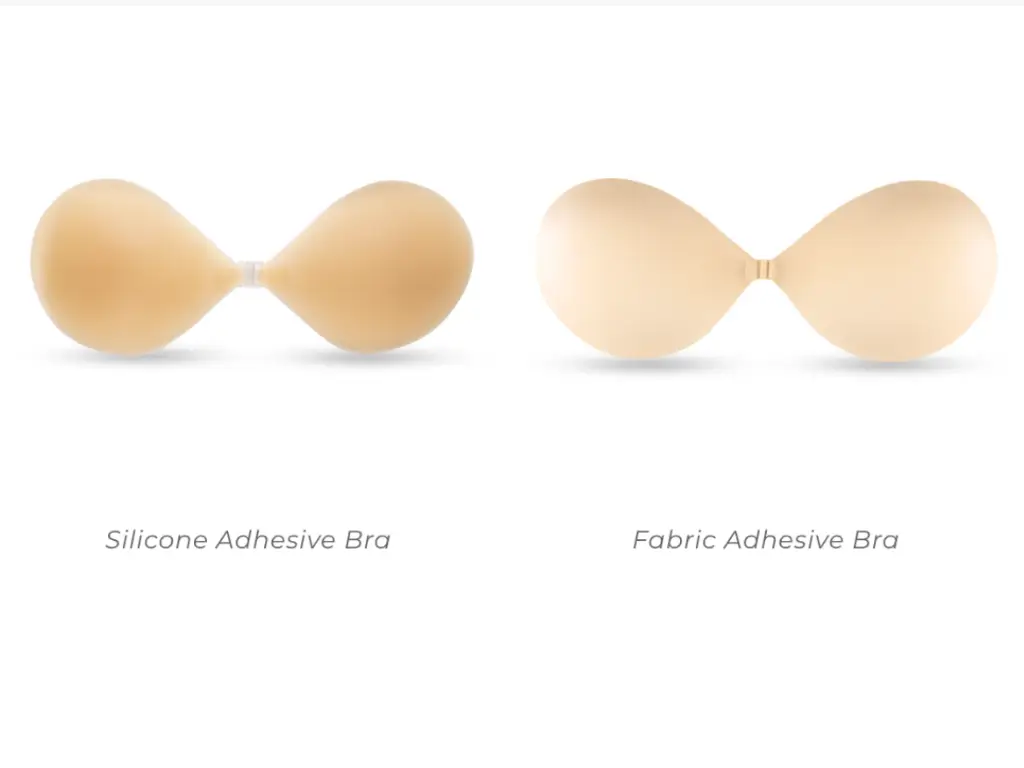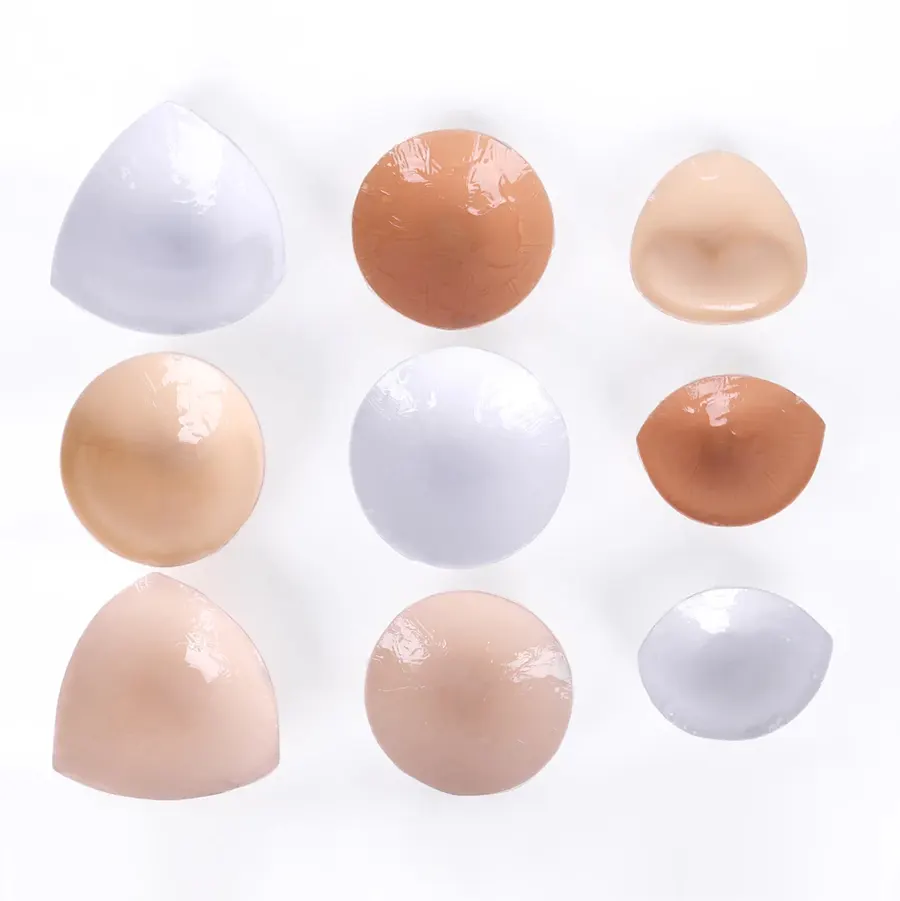
A buyer who classifies bra inserts by one feature ends up rejecting the wrong samples. Silicone, foam and fabric-covered pads each behave differently once you add shape, thickness distribution and how the pad is held — loose in a pocket, sewn into the cup, or stuck to skin. Naming all five before requesting a quote makes samples easier to compare and reduces mismatched samples, repeated development rounds, and late specification changes.
What Is a Bra Insert?
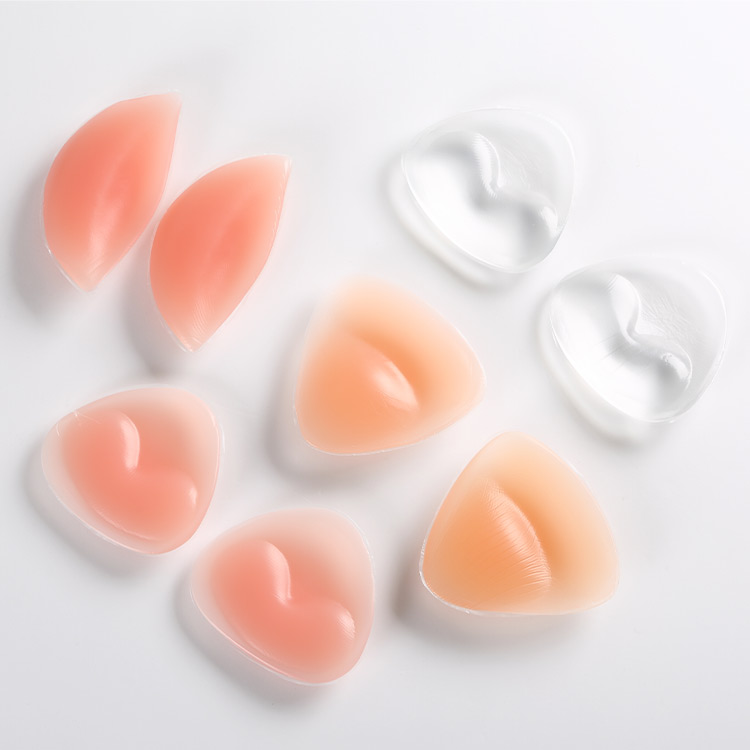
A bra insert is a pad used with a bra or garment to add volume, shaping, coverage, or support. Depending on the design, it may be placed inside a cup pocket, fixed to the garment, or applied directly to the skin.
Removable inserts can often be changed without altering the garment, while fixed constructions must be evaluated together with the cup and garment pattern. That difference is commercial as much as technical: it decides who owns the specification, what ships in the carton, and what has to be re-approved when the cup changes.
Inserts are not a single product. The same “bra pad” label covers foam discs, silicone teardrops, fabric-covered inserts and adhesive lifts. Before comparing any two, sort them along the same five axes used throughout this guide:
- Core material and construction — what fills the pad and how it is built.
- Shape and coverage — footprint, silhouette and how much of the cup it lines.
- Thickness, contour, and edge profile — where the volume sits and how the rim finishes.
- Garment integration — removable/pocketed or sewn-in/fixed.
- Skin attachment — adhesive or non-adhesive.
A pad can be foam and adhesive at once, which is why one-feature classification breaks down. Getting the taxonomy right is a commercial discipline, not a labeling exercise. A buyer who requests “silicone bra inserts” without specifying the other four axes will receive samples that differ on uncontrolled variables, and the comparison becomes meaningless. Worse, an insert approved on the wrong axis can lock you into a pocket, tooling or packaging spec that does not fit the garment you intended to build — expensive to discover after the first order.
Which Core Materials and Cover Constructions Are Used?
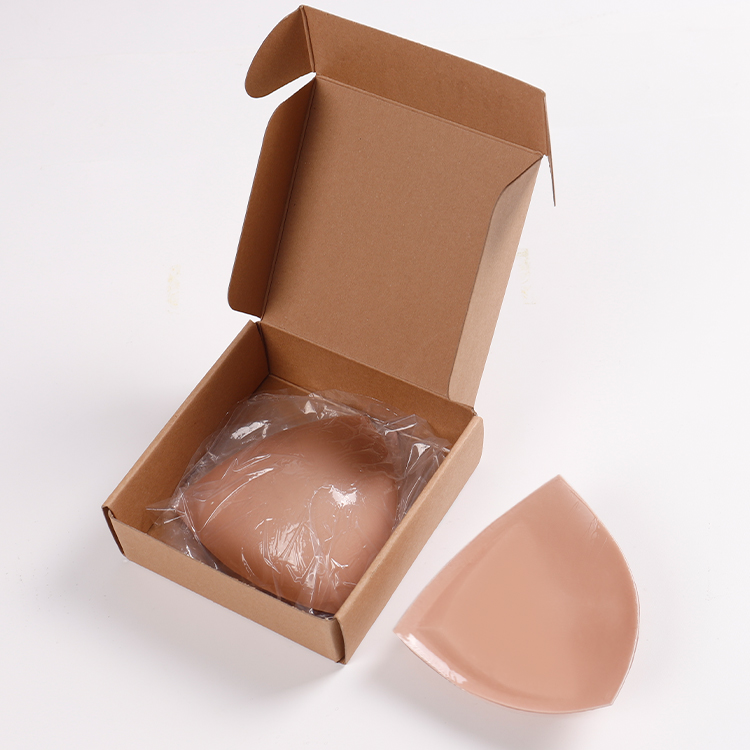
Material drives weight, drape, wash behavior and how the pad reads under thin fabric. Three constructions dominate B2B bra insert programs, and the third is a cover rather than a core.
Silicone pads
Silicone mimics breast tissue most closely, so it wins where a natural silhouette matters. Solid silicone, silicone gel, and film-contained gel constructions can differ in density, softness, and flexibility, so specify which one you are quoting rather than accepting “silicone” as a single option. The trade-off is mass: silicone is generally heavier than foam at comparable dimensions, and that weight has to be carried by the garment or by adhesive.
Foam pads
Polyurethane foam is the workhorse. It is light, relatively inexpensive to die-cut, and available in firmness grades from soft memory foam to high-resilience push-up foam. Foam compresses under the garment and springs back, which suits everyday bras. Water behavior is not one story: absorbency and drying depend on open- or closed-cell structure, density, lamination and any covering fabric, so confirm it on the finished pad instead of reading it off the word “foam.” Heat is the more consistent risk — it degrades loft — which is why care instructions matter.
Fabric-covered pads: a cover, not a core
A knit or microfibre shell is a surface construction over a foam, fibre or silicone core, not a peer of silicone and foam. It improves hand feel and may reduce visible surface shine under a thin T-shirt, and it lets a brand match the cup lining color. The cover also adds a seam and an edge that can be the first thing to print through close-fitting garments.
How material and cover set the cleaning method
Cleaning is the buyer question materials answer fastest, and it is on every spec sheet for a reason. Silicone does not absorb water, so a non-adhesive silicone pad can usually be wiped or hand-washed and air-dried. Foam depends on cell structure and cover: some dry quickly, some hold water and lose loft under heat. Fabric-covered pads sit in between — the cover can be laundered, but the core underneath dictates how much agitation and heat the finished pad survives. Specify the cleaning method for the actual material-and-cover combination before you write a care label, because a wrong instruction quietly shortens the product life the customer judges you on.
| Core material / cover | Look and feel | Best fit | Watch-out |
|---|---|---|---|
| Silicone (solid / gel / contained gel) | Most natural drape and weight distribution | Occasion and invisible-look lines | Generally heavier than foam; needs secure holding |
| Foam (PU / memory; open- or closed-cell) | Light, springy, holds die-cut shape | Everyday and high-volume bras | Water uptake varies by structure; repeated heat may reduce loft |
| Fabric cover over foam / fibre / silicone core | Soft hand; may reduce visible surface shine | T-shirt and seamless garments | Cover is not the core; seam and edge can print through |
A fabric-covered pad is therefore two specifications stacked: the core and the cover. Name both on the quote, or two “fabric-covered” samples from two suppliers can arrive as entirely different products. Xinke’s bra pads range lists silicone, foam and fabric-lined options with size, shape, color, material and thickness customization, which is the combination worth confirming before you shortlist.
One caution: adhesive belongs to the skin-attachment axis, not the material axis. Listing “adhesive” beside silicone and foam is the classification mistake this article exists to prevent — a foam pad can carry an adhesive backing, and a silicone pad can be entirely non-adhesive.
How Do Shape and Coverage Affect Function?
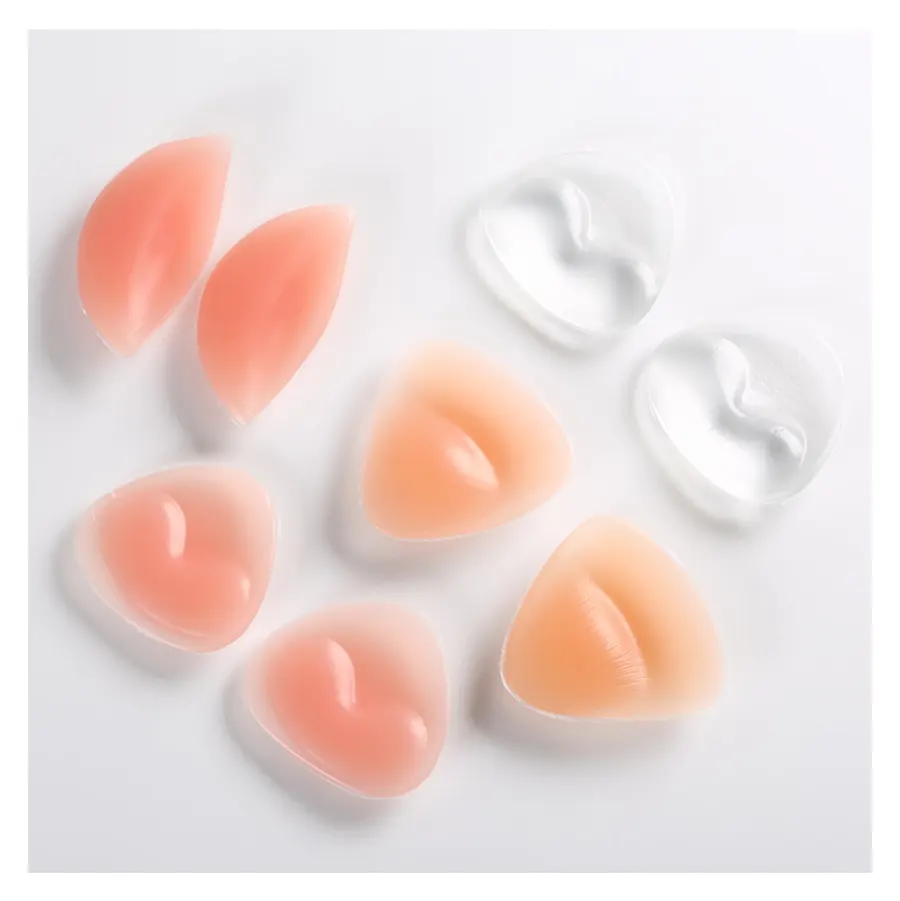
Shape decides where the pad adds volume, and coverage decides how much of the cup it lines. Three common shapes carry different jobs.
Round inserts
A round pad adds even fullness across the cup with symmetric projection, and it carries no orientation rule during packing. That makes it a convenient starting point for a basic T-shirt bra, though whether it is the right default still depends on the cup it has to sit in.
Triangle inserts
Triangle pads line up with the underarm-to-center geometry of a triangle cup, so they suit bralettes and plunge shapes. The pointed end needs correct orientation; a mis-oriented pad shows as a wrinkle at the top of the cup.
Teardrop inserts
Teardrop pads use orientation, thickness distribution and placement to concentrate volume in the lower or side cup, which reads as a push-up silhouette. Because that mass sits low, the holding method matters more: the pad needs a pocket, stitching or adhesive that keeps it where it was placed.
Shape also governs edge profile. A pad that tapers to a thin outer edge disappears under fabric far better than a uniform-thickness disc with a blunt rim, regardless of material.
Coverage rides on the same axis. Full inserts cover more of the cup and may create a smoother transition, while partial inserts concentrate volume or lift in a selected area. The result depends on cup geometry, pad placement, thickness distribution, and edge taper, so judge coverage on the finished cup rather than from a pad photo alone.
How Are Bra Inserts Attached or Integrated?
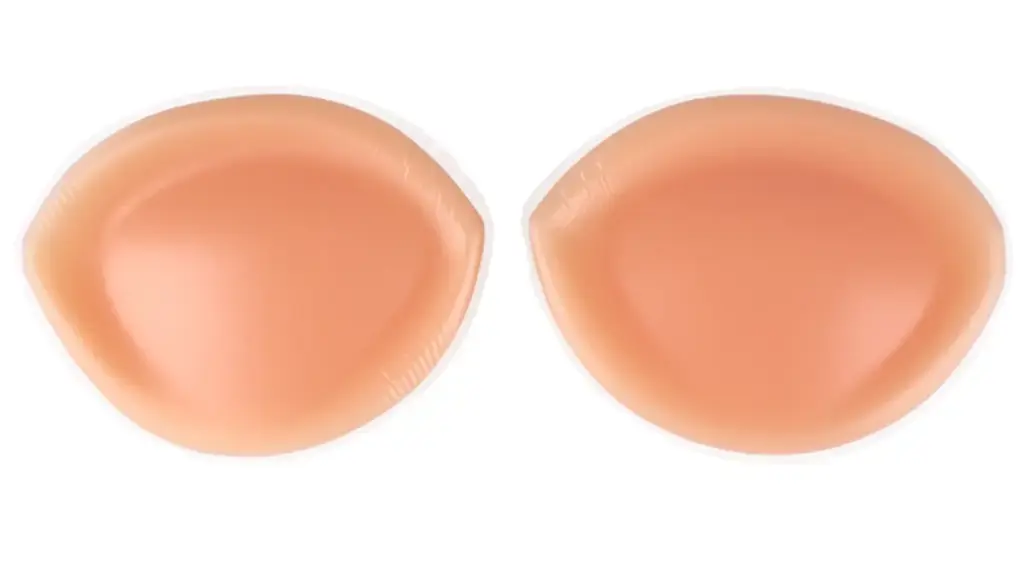
Two different questions live in this section: how the pad meets the skin, and how it meets the garment. Answering one does not answer the other, which is why they sit on separate axes.
Skin-Adhesive vs. Non-Adhesive
Non-adhesive inserts rely on the garment to hold them: they drop into a pocket, sit under a flap, or get stitched in place. Because nothing sticks to skin, they launder with the garment and carry no wear-time limit tied to adhesive fatigue.
Adhesive inserts carry a tackified surface (or a peel-and-stick liner) so the pad grips the body directly. That lets them work in strapless, backless and deep-V garments where there is no pocket to hold a pad. The cost is a closer relationship with the wearer: adhesive strength, skin contact time, cleaning method and shelf life all move onto the spec sheet.
Frame the choice around the garment, not around “adhesive is better.” A line of everyday bras with structured pockets gains little from adhesive; a backless evening piece gains a great deal from it. Because a skin-adhesive insert is a skin-contact component rather than just a padding part, read the supplier’s paperwork by what each document actually proves.
Xinke states that it inspects incoming silicone and TPU materials and maintains ISO 9001 and BSCI-related systems. Buyers should review each document according to its actual purpose: ISO 9001 covers the quality-management system, while BSCI addresses social-compliance practices. An SDS provides chemical-safety information, and SGS, REACH, or California Proposition 65 reports are relevant only when the tested material, model, scope, and date match the product being sourced. For textile components, OEKO-TEX STANDARD 100 may support harmful-substance screening when the certificate scope covers the relevant material or component. None of these documents alone replaces finished-product skin-contact and performance testing. For what certification claims on adhesive bras do and do not prove, see our guide to whether silicone and adhesive bras are safe.
Removable/Pocketed vs. Sewn-In/Fixed
A removable pad slides into an internal pocket and comes out for washing or replacement. Pocketed construction gives the wearer choice and lets a brand sell spare pads. The pocket opening is a known failure point: too loose and the pad migrates, too tight and it wrinkles the pad.
A sewn-in pad is fixed to the cup to reduce shifting or loss during wear and laundering. It provides more consistent positioning, but the wearer cannot remove or reposition it easily. The pad edge, stitching area, cup compatibility, and wash performance should therefore be evaluated together with the garment factory before bulk production.
Whether a program runs removable/pocketed or sewn-in/fixed is a garment-construction decision, and the pocket itself is normally cut and sewn by the apparel maker rather than delivered with the pad. Confirm which part of that construction the insert supplier supplies and which the garment factory builds before you design around either.
| Skin attachment / garment integration | Held by | Cleaning and care | Best fit |
|---|---|---|---|
| Non-adhesive, removable / pocketed | Garment pocket | Remove the pad and clean each component according to its care instructions | Everyday lingerie and bralettes |
| Non-adhesive, sewn-in / fixed | Stitching to the cup | Validate the pad and garment together under the intended care cycle | Sports bras, activewear, and garments requiring stable pad placement |
| Skin-adhesive | Skin-contact adhesive protected by a release liner | Clean the pad separately according to the supplier’s care instructions | Strapless, backless, and deep-V garments |
How Do Thickness, Contour, and Edge Profile Change the Result?
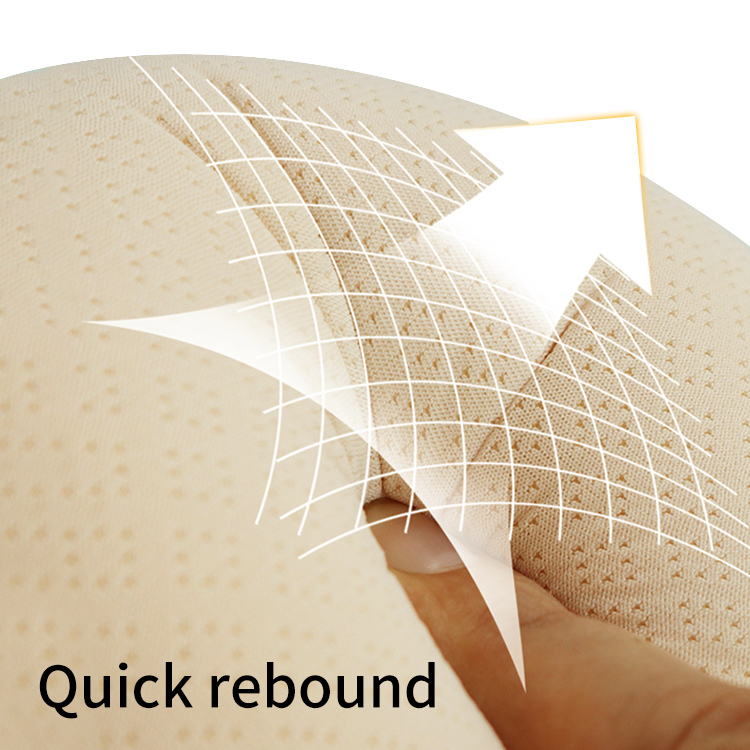
Thickness is where “invisible” and “shaping” pull against each other. A center-thick / edge-thin gradient — the contour most inserts use — adds volume at the front while feathering to a thin rim that vanishes under fabric. A uniform-thickness pad is simpler to make but shows its whole perimeter as a line under a tight top.
Two variables ride on thickness: pair weight and edge profile. Where material, surface area and construction stay the same, a thicker pad also adds mass that the garment or adhesive must carry, so record grams per pair at each thickness option instead of assuming the step is trivial. Edge profile is a separate specification: a blunt rim can create a visible line, but so can a pad whose projection does not match cup depth, which is why the two should be assessed together on the actual garment.
Contour is where the five axes interact. A lower-thicker teardrop can concentrate volume in the lower or side cup, but the required holding method depends on total pair weight, cup geometry, movement, and the support provided by the garment. Shape alone does not determine whether an insert must be adhesive. A specification such as “silicone, medium” still leaves contour, edge profile, weight, and attachment undefined, which is why apparently similar samples may perform differently.
Once these construction variables are defined, the next step is to match them to the garment application. Swimwear, lingerie, sportswear, and dresses place different demands on water resistance, movement, cup structure, and visibility.
What Should Buyers Compare Before Requesting Samples?
Before you ask for samples, write the complete insert spec across all five axes so that suppliers quote the same thing. An ambiguous “we need silicone pads” invites a dozen non-comparable samples, and a short request-for-comparison sheet protects your evaluation time.
- Core material and construction: solid silicone, gel or contained gel; foam type with cell structure and firmness; which core sits under a fabric cover — plus the color or skin-tone target.
- Shape and coverage: round, triangle or teardrop; footprint against the cup size; full or partial coverage.
- Thickness, contour, and edge profile: center-thick/edge-thin gradient, rim taper, and total grams per pair.
- Garment integration: removable/pocketed or sewn-in/fixed, and which party builds that part of the garment.
- Skin attachment and care: adhesive or non-adhesive, plus the wash and dry method the end user will actually follow.
Then test in the garment rather than in the hand: lay two candidates side by side in the actual cup, under the actual shell fabric, and check edge visibility, hold and wash behavior. A supplier that supports customization of size, shape, material and thickness lets you converge on one comparable spec instead of shopping a catalog, and it helps to know what the tooling conversation looks like first — see how to customize a silicone bra in a factory.
Frequently Asked Questions
What are the different types of bra inserts?
This guide sorts them on five axes: core material and construction; shape and coverage; thickness, contour and edge profile; garment integration (removable/pocketed or sewn-in/fixed); and skin attachment (adhesive or non-adhesive). Compare all five together rather than one label, because a pad can share a material and differ on everything else.
What materials are bra inserts made from?
Common cores are silicone (solid, gel or film-contained gel) and polyurethane foam in an open- or closed-cell structure, with a knit or microfibre cover as a surface construction over one of them. Adhesive sits on the skin-attachment axis, not the material axis.
How does bra insert shape affect lift and coverage?
Round pads give even fullness with no orientation rule, triangle pads follow triangle-cup geometry, and teardrop pads use orientation and thickness distribution to place volume lower or to the side for a push-up effect. Full coverage lines more of the cup for a smoother transition; partial coverage concentrates the effect in one area, and the outcome depends on cup geometry, placement, thickness distribution and edge taper.
What is the difference between adhesive and non-adhesive bra inserts?
Non-adhesive inserts rely on the garment — a pocket or a sewn-in position — and launder with it. Adhesive inserts grip the skin directly, which enables strapless and backless wear but adds adhesion, wear-time, cleaning and shelf-life specs that have to be tested on the actual model.
What should brands check when comparing bra insert samples?
Compare the complete spec across all five axes — core and cover, shape and coverage, thickness and edge profile, garment integration, skin attachment — inside the actual garment and under the shell fabric. Edge visibility, pair weight and hold decide the winner, not the catalog label.
Final Thoughts
Bra inserts are not one product with variations; they are a combination of five independent variables — core material and construction, shape and coverage, thickness and edge profile, garment integration, and skin attachment. Naming all five before you request a quote is what makes two samples comparable, and it protects both your evaluation time and your return rate.
Once the spec is written, request comparable samples from a supplier who can match the pad to the garment structure and intended use, and evaluate them in the finished cup before anything is locked into tooling or packaging.