Boob tape looks like the simplest SKU in the adhesive category. No lo es. Two rolls of the same width and claim can lift differently an hour into the same event, because a roll is five stacked components, each either specified or defaulted.
This guide is for the buyer who must specify those layers before sampling: backing, coating, format, the repositioning boundary, and the carton wording. Whether tape or covers suit your assortment, and how the tape is worn, are answered elsewhere on this site; the decisions below belong in the purchase order.
What a Boob Tape SKU Is Made Of
Order the same product name from three factories and you get three different objects: the name describes the use, not the build. Every lift tape is five layers — the backing, the pressure-sensitive adhesive coated onto it, the release liner, the slit geometry that turns a master roll into a saleable width, and shelf-stable packaging.
Each layer owns a different part of the result. The backing carries the load and sets stretch, recovery and breathability. The coating sets grab speed and holding time. The liner governs unwind quality and cleanliness; slitting sets the width tolerance and edge quality; packaging governs shelf life.
A brief that names only a product and a target price leaves four of those layers to the factory’s defaults. The SKUs listed under the fabric adhesive bra category share this layer logic across visibly different constructions. Fix each layer in writing, or inherit the defaults.
Backing Materials: Where Load, Air, and Removal Feel Live
The backing holds most of the unit cost and all of the mechanical behavior. Three families divide the category, trading stretch, transpirabilidad, removal feel, and sweat tolerance. The general material framework is documented in how to choose adhesive bra material for your brand; what follows is specific to tape.
Woven Cloth: Cotton and Polyester-Spandex Blends
The lift-work default. Public listings show plain-weave cotton or a 95 percent cotton / 5 percent spandex blend — market reference points, not a Xinke specification. Cotton stretches moderately and reads breathable; the blend recovers better through a long day. Woven edges catch fibers on removal, and sweat-loaded cotton dries slowly.
PU Film
Delgado, translúcido, and highly elastic: the film meant to disappear under sheer fabric. Its edges lie flatter than cloth, and sweat sits on the skin side rather than soaking the carrier. Trade-offs: lower breathability through the film and one sharp, continuous pull on removal. Film transmits every slitting tension error, so edge quality must be inspected.
Silicone-Coated Cloth
A weave carrying a silicone layer: cloth strength with a softer, conforming skin side and better behavior around perspiration. It costs more per meter, and the coating changes how the adhesive bonds to the backing — a formulation proven on cotton needs re-testing. Treat it as a separate qualification, not a drop-in upgrade.
Match the family to the channel: formalwear and sheer-fabric retail reward PU film; everyday lift and garment-securing run on woven cloth; comfort-positioned brands are where silicone-coated cloth earns its cost. One rule binds all three — the backing sets the ceiling on what the coating can hold.
Revestimiento adhesivo: Peso, Pattern, and Grab versus Hold
Coating weight — grams per square meter of backing — quietly decides most complaints. A heavier coat grabs faster and resists edge lift, but raises removal force and residue on skin and hems. A lighter coat removes cleanly but gives up holding time. Public listings quote coat weights in the tens of grams per square meter; the range Xinke coats to on a given backing is [待确认], so state a target range in the PO.
Pattern matters as much as weight. A continuous coat gives maximum grip and maximum sweat trapping; dots, stripes, or a gradient denser at the ends lower removal force and put grip where the load concentrates. Fix pitch, open area, and coverage in writing, and specify an adhesive-free border so the wearer has a corner to lift.
Then separate the two jobs. Initial tack is how fast the tape grabs on contact — what holds a lift while the next strip is positioned. Cohesive hold is how long that grip survives sustained movement; a coating can be strong on one and weak on the other. Which chemistry produces which balance is covered in what adhesive is used on sticky bras, not repeated here.
Ancho, Length, and Format: Rollos, Pre-Cuts, and Shaped Pieces
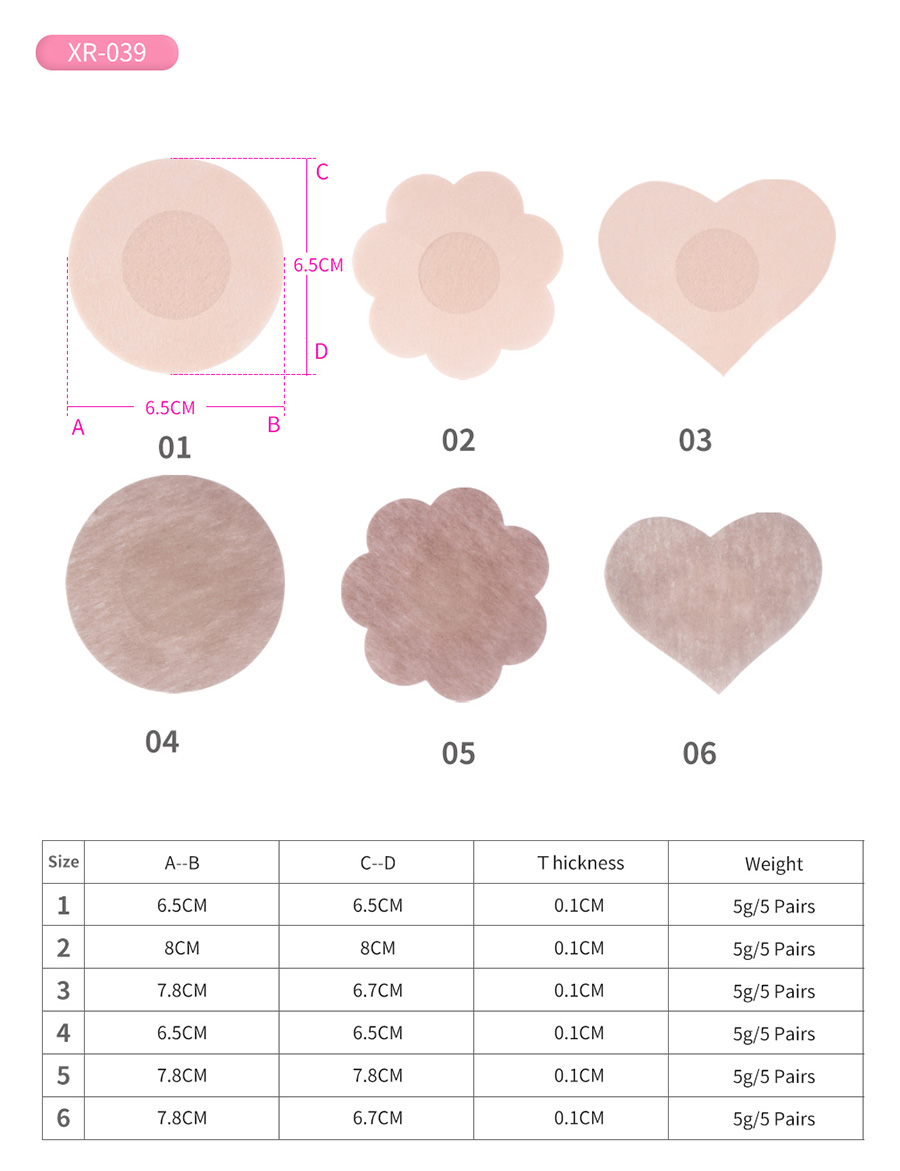
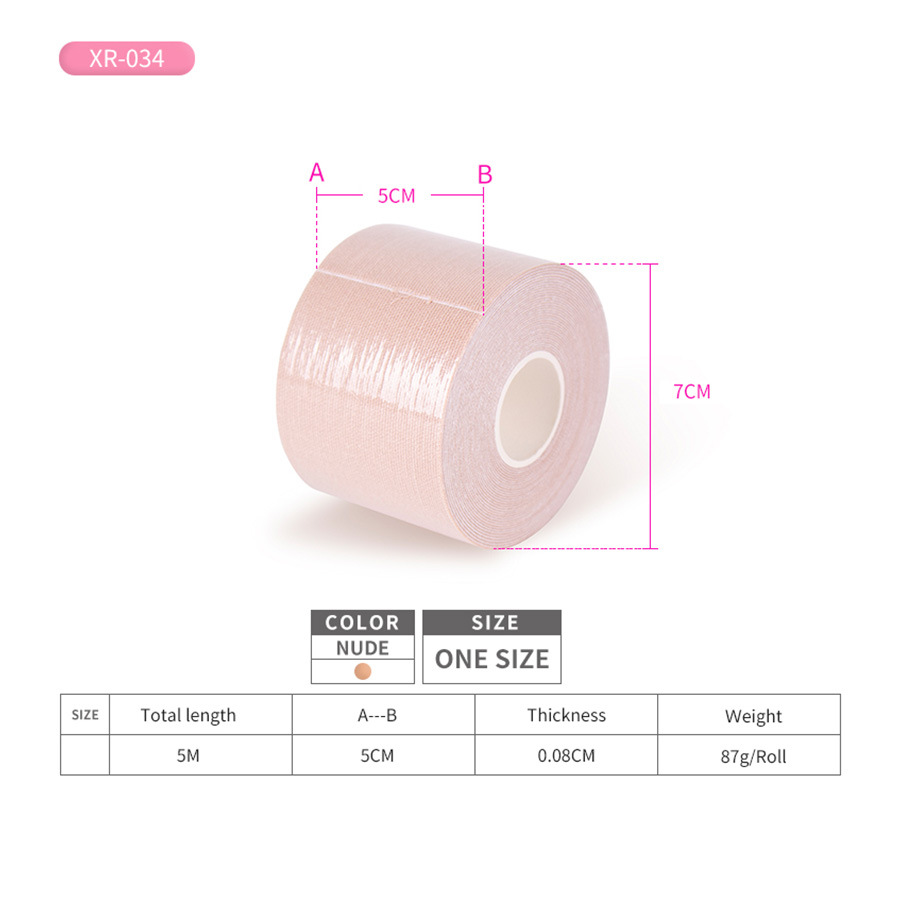
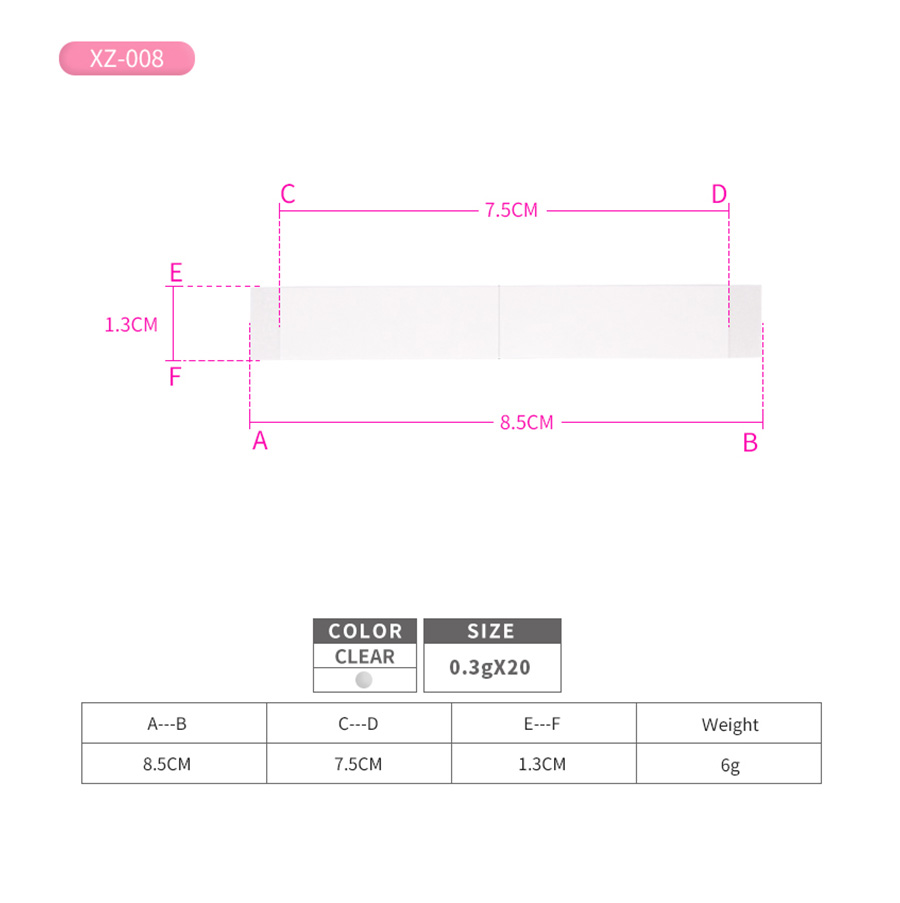
Format decides who owns the fit. Rolls — public listings show width steps around 5, 7.5, y 10 cm on roughly 5 m lengths, market reference rather than a Xinke quotation — let the wearer cut their own geometry and their own mistakes; el breast instant lift boob tape SKU is sold on that basis, listed as a cut-freely roll. Pre-cut strips standardize the application, and shaped pieces pre-decide the contour and move the die cost to you. Double-side adhesive clothes tape bonds garment to garment and rides the same lines with different acceptance criteria.
| Backing | Stretch and breathability | Removal feel | Typical width-length format (public listings) | What to fix in the PO |
|---|---|---|---|---|
| Woven cotton | Moderate stretch, respirable, slow drying after sweat | Softer rip; catches fine hair at the edge | Rolls at the mid width step; pre-cut strips | Blend ratio, weave direction, coat weight range |
| Polyester-spandex woven | Higher stretch with better recovery; respirable | Between cotton and film; follows coat coverage | Rolls at narrow and mid width steps | Elongation percentage, recovery, pattern pitch |
| PU film | Alta elasticidad; low breathability through the film | Sharp, continuous pull; lies flat at the edge | Rolls at narrow steps; shaped pre-cut pieces | Film thickness, slit-edge quality, border margin |
| Silicone-coated cloth | Cloth strength, conforming skin side, sweat-tolerant | Mellower release than the uncoated options | Most often pre-cut strips or shaped pieces | Adhesive-backing compatibility; re-qualification evidence |
Width is a load-distribution lever, not a size preference. A wider strip spreads the lift force over more skin and resists edge lift, but total removal force rises with area. Choose the ladder against the use — a securing step is not a lift step — and let format follow the channel: rolls where buyers cut, pre-cuts where they grab.
Repositioning, Eliminación, and Skin-Prep Limits
Repositioning is a specification decision. Once the coating has set against skin, its second placement grips less than the first. Decide before sampling whether your pack states a reposition count within one wear or a single placement, and verify it on wear samples. Re-wearable SKUs should defer their care text to how to make an adhesive bra sticky again rather than improvise one.
Removal is set by coat coverage, width, backing stiffness, and the border margin — all four yours to fix before bulk. For acceptance numbers, public listings reference ASTM D3330/D3330M, the standard test method for peel adhesion of pressure-sensitive tape, alongside a separate quick-tack (slope) method for initial grab; instruments, procedures, and the standards mapping sit in silicone bra adhesion testing standards, not restated here. Decide which measured value goes into the PO.
Skin prep sits outside the factory’s control and inside your returns data: every adhesion figure assumes clean, seco, product-free skin, and lotion or oil changes the result. Bind wear-duration claims to the tested prep condition and print it on the insert card.
Claim Boundaries on Latex, Irritation, and Approval Wording
Three wordings come up most in buyer requests, with different evidence loads. Latex-free is a formulation statement: no natural rubber latex in backing or coating. It is defensible with a component declaration and a test report naming the actual SKU — and it says nothing about irritation, so it must not become a sensitive-skin message on the packaging.
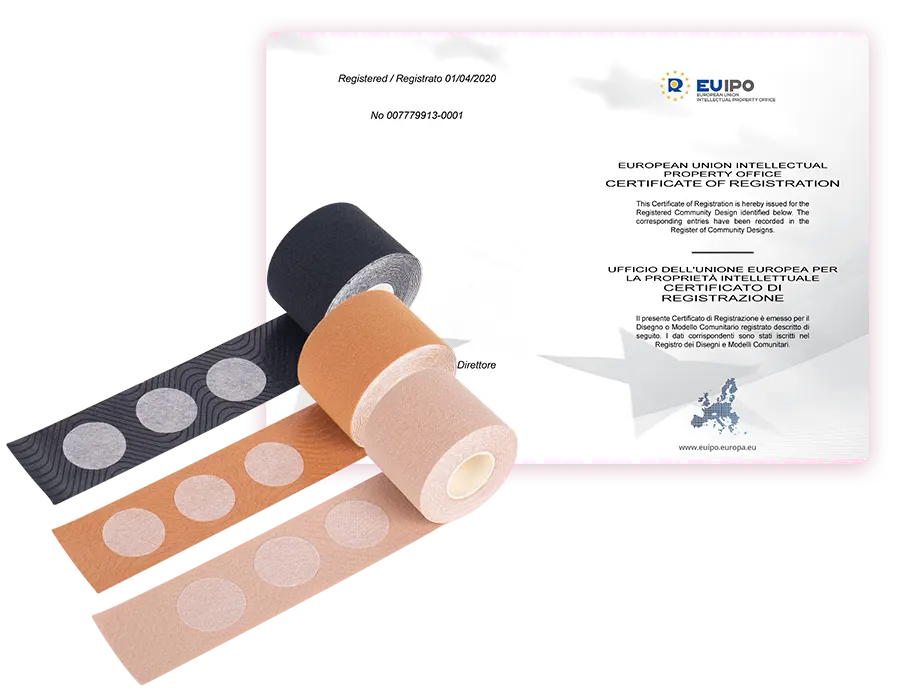
Approval wording is the sharpest edge. An FDA approved claim refers to a defined premarket process for higher-risk devices, described in 21 CFR Part 814, the premarket approval program for medical devices. Boob tape sold as a garment accessory is outside that process, so an FDA approved label on the carton is a wrong statement whatever a facility’s paperwork says. A registration number does not convert into approval wording.
Irritation wording stands or falls on patch-test data against the finished article you ship; a material certificate is not a substitute. The evidence-package logic is worked through in our materials and certifications question-and-answer page. Every strong word on the carton should map to a document you can name.
Private Label Setup: Cards, Cartons, Cores, and Tiers
Private label on tape is a packaging program with a product inside: hangtag or header card, instruction card with diagrams and language list, outer carton, the reel-core print, and the tier quantities each element commits to. Comparable public listings open custom programs at tiers from dozens to a hundred-plus rolls — market reference figures, not a Xinke quotation. The binding constraint is the print: every color carries its own setup, so a first program is one artwork across few colors.
Print methods, Pantone matching tolerance, and the multi-language card rules are covered in custom packaging for silicone nipple covers, not re-listed here. What is tape-specific is the sequence: lock the format ladder first, because each added format multiplies the packaging SKUs — six formats in two card languages is twelve order lines before the first pallet ships.
The remaining choices are commercial: branded or neutral core print, one instruction card shared across formats or written per format, and tier pricing by roll counts or carton counts. The broader sticky-garment family sits under the categoría de sujetador adhesivo as a reference for shared platform potential.
Preguntas frecuentes
Can you reuse boob tape?
Treat reuse as a specification decision; the answer differs by build. A woven backing with a heavier continuous coat often survives one careful reposition within a wear; a PU film strip is built for one placement. Across wear days, liner and coating quality decide. Bind any pack statement to a wear test on the shipped format, and defer re-wearable care to the site’s re-tacking guide.
Do you have to use nipple covers with boob tape?
That is a wearing decision, answered in full in cubre pezones versus cinta para senos rather than repeated here. The buyer-side consequence: an uncoated central window die-cut to spare the nipple on removal changes both the tooling and the insert card, so it belongs in the die file and the artwork explanation.
What should I send a China customized boob tape supplier?
A parameter list, not a reference photo. Send: backing family and blend ratio; target coat weight range and pattern; width and length per format; liner type; adhesive border margin; the reposition statement; carton, card, hangtag, and core print with color counts; tier quantities per SKU line; and the evidence documents behind each artwork claim. Quotations from that list are comparable; a photo leaves several items as someone else’s default.
What width should I start with?
Start from the market’s standard steps: public listings cluster around narrow, mid, and wide bands in roughly the 5 a 10 cm range — a market reference, not a Xinke recommendation. Narrow suits garment-securing and edge work, mid suits general lift, wide only where the channel accepts heavier removal. Test two steps in one drop and let reorder data pick the third.
Pensamientos finales
Boob tape is a five-layer specification wearing a one-word product name. The backing carries the load, the coating decides grab versus hold, the format decides who owns the fit, the repositioning boundary decides what the pack states, and the claim wording decides what the artwork review needs. Each is a PO line or someone else’s default.
Write the defaults out of the order: fix the blend, the coat weight range and pattern, the width ladder, the border margin, the reposition statement, and the evidence behind every word on the carton. Sample against that sheet, not a photograph, and compare factories line by line — that is how the program arrives as the product you designed, not the line’s default stock.